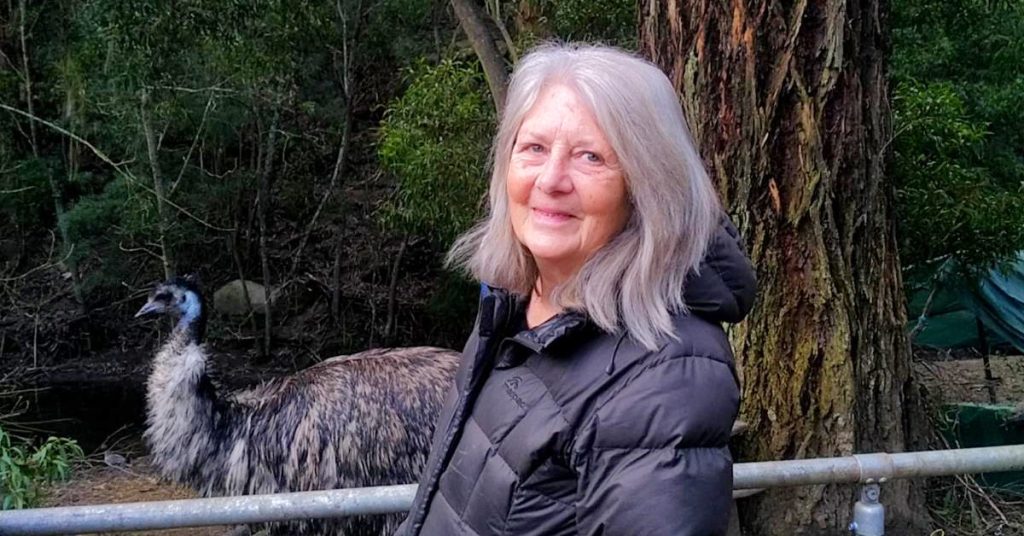
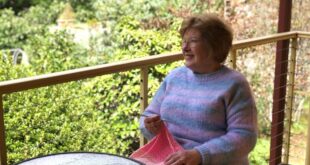
Chris Oddie at a local wildlife sanctuary which is supporting the program. (Photo: Quintin Handley)
Story by Quintin Handley
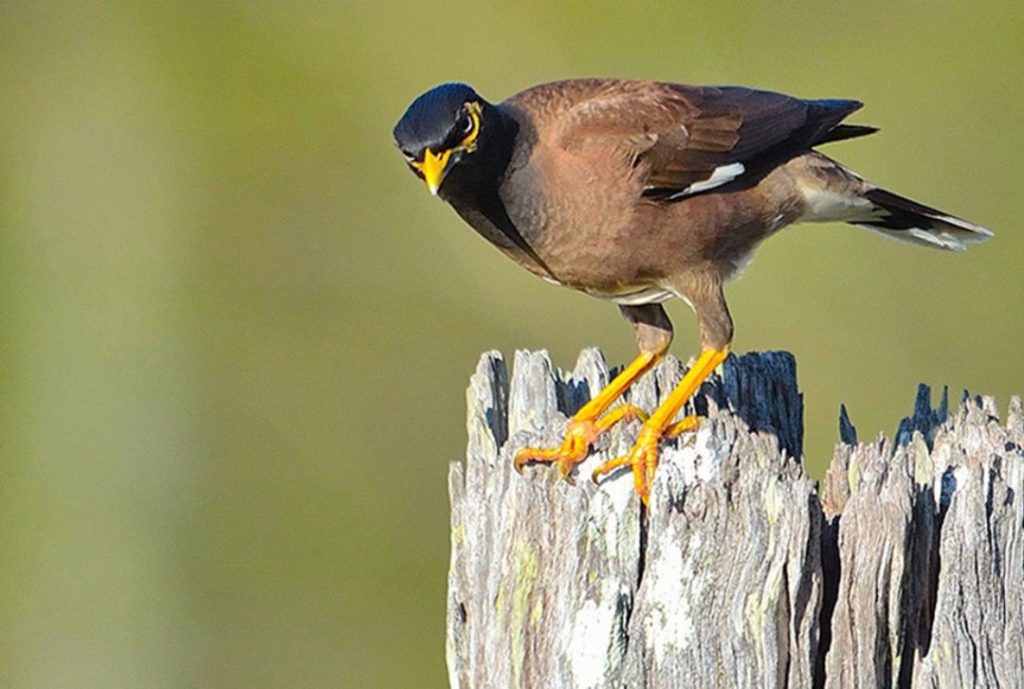
Chris Oddie is a grandmother, a retired cook, and a passionate member of the Lithgow Environment Group (LEG). She lives in Lithgow in a home she and her son have renovated. With other members of LEG, she became increasingly concerned about the growing number of invasive Indian Myna birds proliferating in Lithgow. Mynas were listed among 100 of the world’s worst invasive species by the World Conservation Union (IUCN) in 2000.
Key Points:
Indian Myna birds are more harmful than they seem. When they arrive in an area they habitually kill the chicks of native birds, break their eggs, and steal their nesting sites. They also carry dangerous diseases which can be deadly to both native wildlife and humans.
The Lithgow Environment Group carefully weighed up the ethical dilemma of how to reduce the risks these birds pose to humans and wildlife and made the difficult choice to engage early in an eradication program before numbers of the birds expand to unmanageable levels.
A community run program has now removed hundreds of these invasive and dangerous birds from the Lithgow Area in the last eight months.
The negative impact of the Indian Mynas on local wildlife cannot be overstated. They have been known to kill the chicks of native birds, destroy their eggs, invade and evict them from their nesting sites, and prey on rare native insects and lizards. Additionally they carry dangerous diseases which can be deadly to both native wildlife and humans.
While trying to decide how to protect both humans and wildlife, LEG looked into a program initially designed by the Canberra Indian Myna Action Group. They were founded in 2006 to combat the spread of this harmful species in the ACT. Their Myna eradication program has since been exported, adapted, and adopted by other groups around the country to suit their local needs. There are now more than thirty such groups in New South Wales alone. The Canberra based group has removed over 80,000 birds from their area in the eighteen years of their program and seen a significant increase in local bird populations during the same time period.
LEG faced internal debate surrounding the ethical consequences of beginning such a program, mainly focused around whether it was possible to remove enough birds quickly enough to make a serious positive impact. After investigating the results attained by the Canberra based group, LEG concluded that it was possible to run a program that could effectively reduce the local numbers to a level where the environmental benefits outweighed the ethical concerns raised by some members.
There have been precedents around Australia where it has been critical to eradicate introduced species to save local native species.
We wrote about one such precedent in Katoomba Area Local News last year:
“After a ship ran aground near Lord Howe in 1918, an unfortunate stowaway invaded the pristine island: black rats. They decimated the island’s main crop, the Kentia palm seed, and its rare birdlife” (No Man is an Island – The Naturalist, Katoomba Local News).
Fortunately an extensive rat eradication program has resulted in the recovery of the island’s rare birdlife.
After LEG secured a grant from the Foundation for Rural and Regional Renewal, Chris put up her hand and began running a community program from her backyard last September. Spearheaded by LEG and run entirely by volunteers, with support from Secret Creek Wildlife Sanctuary and Lithgow Men’s Shed, the program has been ethically and humanely trapping and culling hundreds of Myna birds in Bathurst, Hartley, Wallerawang, Portland, Meadow Flat and Lithgow.
In the wake of their removal native birds have been quickly reoccupying areas, and the local ecosystem is being restored to its natural balance. “There are more native birds coming back,” said Oddie, of the recovery of local wildlife observed by her volunteers in the vicinity of their trapping programs. Superb Fairy Wrens, Black Cockatoos, and Regent Parrots are all birds subject to the Myna’s destructive habits, and soon repopulate areas free of the Indian Mynas.
Strategies we can all take to deter Indian Myna birds
“Mynas like tidy lawns, manicured hedges and hard surface areas, so creating a more bushlike native garden will help keep them away. They are attracted to fruit trees, palms and pines. Removing pet food and covering compost bins will deter both mynas and miners.
Attract more native birds by offering water in bird baths, building myna-proof nesting boxes (PDF 443KB) and planting locally native trees and shrubs – the most deterring habitat is dense tree canopies and thick shrubbery.”
This story has been produced as part of a Bioregional Collaboration for Planetary Health and is supported by the Disaster Risk Reduction Fund (DRRF). The DRRF is jointly funded by the Australian and New South Wales governments.
The KTOWN pickers - Katoombans Taking On Waste Now - are clearing litter from local tracks and streets and stopping it from entering our waterways and eventually our water supply. Read more in Katoomba Area Local News (link in profile): https://www.katoombalocalnews.com/ktown-katoombans-taking-on-waste-now/
This Saturday will be the first meeting of the Upper Mountains Seed Saving and Gardening Group at the Planetary Health Centre, starting at 10am. Register your interest here (link in profile): https://bit.ly/3LalNFy
It will be followed by the Planetary Health Bushcare group at 1.30pm. Register your interest here (link in profile): https://bit.ly/49k8PPo
Global poisoning by a tsunami of toxins that are flooding the planet is fast becoming the biggest threat to life on earth. Extreme weather events like fire and flood accelerate this chemical pollution. To address this the Planetary Health Centre`s Full Cycle 2025 conference from 20-22 Nov is bringing together leading experts in managing extreme weather events as well as those who are working on reducing the risk of hazardous materials like asbestos and PFAS. According to keynote speaker Julian Cribb:
"The poisoning of our planet through human chemical emissions is arguably the largest human impact of all upon the Earth. In volume, it is four to five times greater than our climate emissions (which are a part of it), and three times more lethal than the estimated climate death-toll. It is the mega-threat least understood by society, monitored by science or regulated by government. It has mainly occurred over the last 50 years, due to a massive global surge in chemical use and materials extraction.
Scientific assessment has identified more than 350,000 man-made chemicals. The US Department of Health estimates 2000 new chemicals go on the market every year and the Smithsonian says 1000 new compounds are now being synthesised every hour. The UN Environment Program warns about a third of these “are persistent, able to accumulate in humans and animals and are toxic”.
The World Health Organisation estimates that 13.7 million people — one in every four — die each year from diseases caused by “air, water and soil pollution, chemical exposures, climate change and ultraviolet radiation”, caused by human activity.
Human chemical emissions are thus responsible for the largest mass killing in history.
Learn more and register for the conference here (link in profile): www.fullcycleconference.com.au
There will be a free community expo on Saturday 22 November at the Planetary Health Centre in Katoomba.
Conference volunteers receive free registration. Email planetaryhealthevents@bmcc.nsw.gov.au if you’d like to volunteer at this critically important event.
T`ai-chi and Qigong routines can increase mobility and strength, improve immunity and help build an inner calm. To get the greatest health impact you need to practice them on a regular basis, so we`re thrilled to now be offering a 6-week block of classes to take you into summer starting 9am this Saturday 1 November and running until Sat 6 December. Bookings essential here (link in profile): https://bit.ly/4qrw4Nx This Saturday, 1 November, the activity is also the first in a full day of Skill Share activities at the Centre that includes Seed Saving and Gardening from 10am, and Planetary Health Bushcare from 1.30pm. You can book in for Bushcare here (link in profile): https://bit.ly/49k8PPo Contact Lis on 0407 437 553 for more information.
Rotarians 4 Planetary Health will be meeting again at the Planetary Health Centre at 6pm on Monday 27 October. Register at this link if you`d like to attend! (link in profile) https://events.humanitix.com/rotarians-4-planetary-health-l7bb4qhr?
Thank you to everyone who popped by for the @ediblegardentrailbluemountains today! It was a great day discussing gardens, ponds, frogs, seeds, composting seats, wicking beds and how to restore the hydrological cycle! Next Saturday will be our Skill Share Saturday. We`ll be kickstarting a 6-week block of Tai Chi & Qigong at 9am, launching our Seed Saving and Gardening Group at 10am and running our monthly Bushcare Group at 1.30pm. You can book in for Tai Chi here (link in profile): https://events.humanitix.com/tai-chi-and-qigong-six-week-block-spring-2025-qaw2ts2v and to Bushcare here (link also in profile): https://events.humanitix.com/planetary-health-bushcare-spring-summer-2025
The Planetary Health Centre is on the Edible Garden Trail today! Last week we launched the Upper Mountains Seed Savers and Gardening Group. Come along to learn more, enjoy a coffee in our garden, and pick up a free Vegetable and Flower Sowing Guide. We`re open from 10am. You can find us at 33-39 Acacia St Katoomba. Tickets for the Edible Garden Trail available here (link in profile): https://events.humanitix.com/blue-mountains-edible-garden-trail-2025
The Planetary Health newsletter is now out. Read about three days of innovation at the upcoming Full Cycle Conference in Nov, the Edible Garden Trail this weekend, and a six week block of Tai Chi and Qigong classes at the Planetary Health Centre (link in profile): https://bit.ly/47jbFBz
Today is an Extreme Bushfire Danger Day! Have you heard about the extraordinary fire resistant paint developed by Professor Yeoh and his team at UNSW? Professor Yeoh will be presenting at our Full Cycle Conference on Thurs 20 November. He is world renowned in the field of fire safety and his innovations are helping to keep people and property safe. Importantly among these innovations has been the development and commercialisation of FSA FIRECOAT paint (sold at Bunnings), which creates a protective insulating ‘char’ on a building when it’s exposed to flames. It is water based and non toxic. Watch it in action in this video (link in profile): https://www.youtube.com/watch?v=SkA1RlxMjWQ
Join us at the Conference to learn more about Professor Yeoh’s work during three days of innovation and exploration in which leading speakers from around Australia will share how we can reduce the risks of natural hazards and hazardous materials. Places are limited so register here now (link in profile): https://www.fullcycleconference.com.au/
With new modelling suggesting a hot summer with increasing fire risk it`s worth making time now to learn more about how we can reduce the risk of disaster by registering to attend the Full Cycle Conference that`s bringing together the Bushfire Building and Asbestos & Hazardous Materials Management Conferences in Katoomba on 20-22nd Nov. Group discounts apply if you register now here (link in profile): www.fullcycleconference.com.au
• Emma Whale from the NSW Reconstruction Authority will discuss how state-wide and place-based disaster adaptation planning is helping reduce risk;
• David Sanderson, the inaugural Judith Neilson Chair in Architecture at UNSW, will share the results of a landmark enquiry on how our response to disasters requires a change in housing policy and local government empowerment;
• Owen Price, Director of The Centre for Environmental Risk Management of Bushfires at UOW will compare the patterns of housing loss in the NSW and Californian wildfires;
• Guan Heng Yeoh from UNSW will share how he developed the award winning FIRECOAT fire resistant paint;
• Everson Kandare from RMIT University will discuss the development of fireproof cladding made from molasses-cultured mycelium - a fungal biomass;
• Alan Green from the Sustainable Buildings Research Centre UOW will introduce Heatwave and Multi-Hazard Resilience Star Rating Tools for retrofitting houses;
• Emma Bacon from Sweltering Cities and Dr Kim Loo from Doctors for the Environment will discuss heat waves and social justice;
• Andrew Bovis from Integrated Water Solutions will discuss the potential use of treated blackwater as an independent water source for landscape hydration and fire fighting;
• Sara Jane Wilkinson from UTS will launch the Bushfire Retrofitting Toolkit for older Australians and do a session on green roofs and walls to reduce disaster risk and increase biodiversity;
• Melissa Knothe Tate will discuss research on tackling PFAS contamination;
Thank you to everyone who participated in our inaugural Blue Mountains Food Security Fair today. It was an inspiring and thought provoking day with lots learnt, many connections made, amazing food consumed and stunning weather! We look forward to doing it again next year!
The inaugural Blue Mountains Food Security Fair kicks off at 9am today at the Planetary Health Centre in Katoomba. Pop in to listen to a talk, watch a demo, grab a coffee and sweet treat from Good Fat Pastry, a delicious lunch from Bibi`s Kitchen, fresh mushrooms from EarthRising Mushroom Farm, locally acclimatised vegetable seeds from Mid Blue Mountains Seed Savers, and edible native plants from Muru Mittigar Ltd You can view the full program here (link in profile): https://bit.ly/4nOSJle The Planetary Health Centre is at 33-39 Acacia St (former Katoomba Golf Course).
The Fair is a World Animal Day event and has been supported by a sEEd grant from the Australian Association of Environmental Educators.
Quintin is a student studying history at the University of Sydney and a graduate of Penrith High School. He is currently writing for the Blue Mountains Planetary Health Initiative’s Local News and wishes to pursue a career in journalism.